

In July and August, SkeyDrone’s EventWatch solution monitored drone activity at several major outdoor events in Belgium, generating thousands of detection points and hundreds of flight tracks. The data reveals several trends that event organizers, security teams and public authorities should be aware of.
1. Drones Are Now Part of the Event Landscape
One observation stood out across all events: drones are no longer exceptional.
In total, we’ve detected 888 drone flights, originating from more than 100 different drones. This means that each drone conducted about 9 different flights on average, indicating that operators frequently fly multiple missions throughout the day rather than a single flight.
This leads us to conclude that large events are no longer occasional hosts of drone activity. They have become drone-rich environments where aerial operations must be expected and managed.
2. Not All Flights are Authorised
Many of the detected flights supported legitimate activities such as media production, event operations and security monitoring. However, unauthorised drones were also observed, highlighting a growing challenge for event organisers and security teams.
As drone adoption continues to increase, the question is no longer simply whether a drone is present. The real challenge is determining whether that drone is authorised to operate in that airspace at that time.
Effective airspace management therefore requires more than detection alone. It requires the ability to identify, track and assess drone activity in context, enabling security teams to quickly distinguish legitimate operations from potential risks.
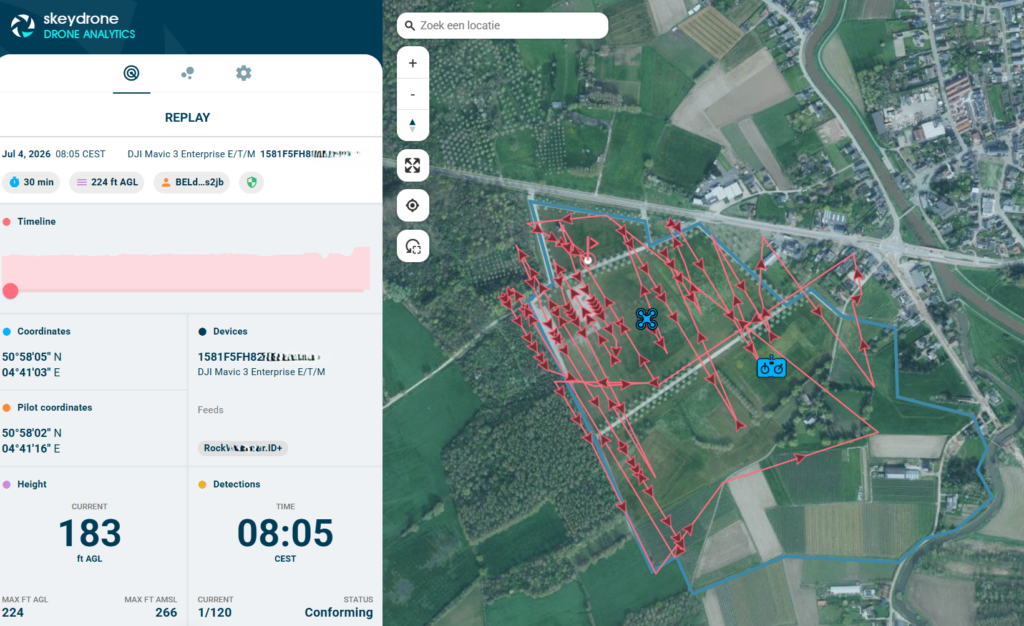
3. Drone Activity Follows the Crowd
Across multiple events, drone operations displayed remarkably consistent patterns.
The highest levels of activity were typically observed during peak visitor hours, particularly between 6 PM and 9 PM, when events reached their highest attendance and operational intensity.
This predictability creates an opportunity. By understanding when drone activity is most likely to occur, organisers can allocate resources more effectively and maintain greater situational awareness during the moments that matter most.
4. Most Drones Fly at Operational Altitudes
Despite occasional high-altitude outliers, most flights remained within the 120-meter limit defined by the EASA open category.
This suggests that most drone flights are carried out for practical purposes rather than extreme-range or high-altitude missions. Common use cases include aerial filming, inspections, security support and operational coordination.
Looking Ahead
The data collected across Belgium’s summer events points to a clear conclusion: drones have become a permanent part of the event environment. As their use continues to grow, organisers need more than simple detection capabilities. They need the ability to distinguish authorised operations from potential risks, maintain situational awareness and make informed decisions in real time. As drones become a standard tool for media, security and event operations, situational awareness in the airspace above an event is rapidly becoming as important as situational awareness on the ground.
Learn more about our EventWatch solution here.