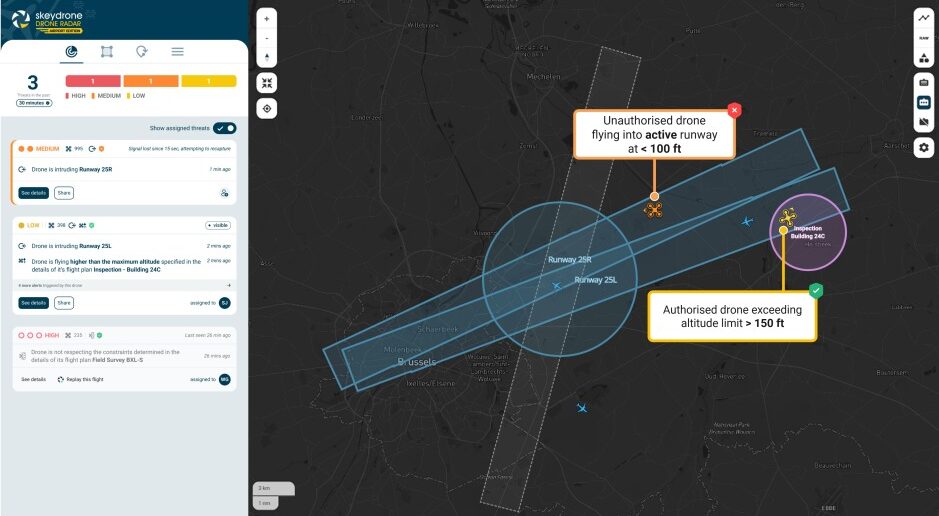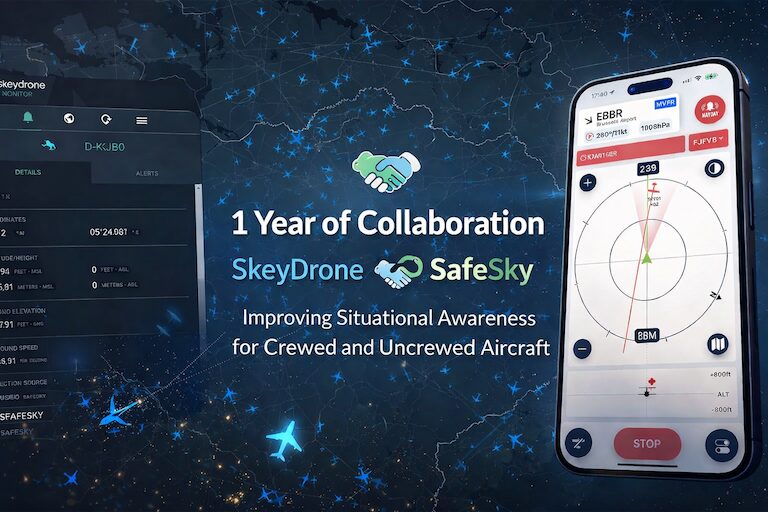
SkeyDrone has launched RunwaySafe, an advanced drone threat assessment solution purpose‑built for airport environments. Developed in close collaboration with airport operations teams and air traffic control, RunwaySafe brings a new level of intelligence to drone incident management.
Unlike traditional drone detection systems that generate alerts for every drone entering controlled airspace, RunwaySafe assesses each event in real time and highlights only those drone flights that pose a genuine and immediate risk to airspace safety or airport security.
The result: fewer false alarms, clearer decision making, and faster recovery after drone incidents.
In this webinar we discussed:
- EASA‑based 3D airport threat zone modelling
- Dynamic runway configuration aligned with live airport operations
- Configurable threat classification logic tailored to your concept of operations
- Seamless UTM integration
- …and more practical insights from real‑world airport use cases
This webinar is a must-see for airport operators, ANSPs, and aviation security professionals looking for a robust solution to drone threat management.
Q&A overview
While the webinar recording doesn’t include the Q&A segment, fear not! We’ve compiled the most pressing questions and expert answers below.
Q: An urgent drone operation from the police received authorisation via a call to the tower instead of via the UTM system. Will it appear as a threat in your system?
A: The software offers whitelisting capability. You can temporarily mute certain operations based on the drone’s serial number or the operator’s ID for a designated period. Additionally, it’s possible to assign a custom label to any drone that has been whitelisted.
Q: Which actions should the airport or air traffic control take when a drone threat has been identified by your system?
A: In addition to implementing technology, it is essential to establish appropriate procedures. How to respond to a drone threat should be described in detail in the rogue drone procedure. This procedure is part of a larger concept of operations (CONOPS). The CONOPS describes when a detection warrants monitoring, when it demands escalation, and when it should trigger a coordinated operational response. This provides structure and clarity for all stakeholders involved in managing drone-related risks.
RunwaySafe is engineered to complement relevant CONOPS by providing a configuration module for threat rule management. The system continuously calculates threat levels in real time according to your specified rules, supporting three distinct threat categories: High, Medium, Low, as well as an option for no threat. This enables seamless integration with CONOPS protocols and facilitates appropriate procedural responses when a drone is detected near the airport.
Q: How does the identification of the drones work?
A: From 1 January 2024, all drones in the EU operating in the specific category and some drones with class marks operating in the open category are required to operate with an active remote identification system (EASA, 2023). This allows for identifying drones remotely in the air and on the ground. Drones broadcasting this signal are called “cooperative drones” and typically do not pose significant threats, unlike non-cooperative drones.
Radio Frequency (RF) detection passively identifies and locates drones by intercepting the radio signals they emit, whether they cooperate or not. An advanced RF-based detection system does not only detect RF signals, but also decodes and decrypts the communication link between the drone and its operator based on info from a continuously updated drone database. By analysing these data packets, the system can extract detailed information such as GPS coordinates, height, speed, and even the drone’s model and its serial number.
Q: Does RunwaySafe rely on AI to predict flight paths and anticipate intrusions?
A: Our system has already recorded more than 100,000 drone flights in the vicinity of different airports and this number is increasing every day. This provides a rich dataset with unique behavioural insights to train AI models. Unfortunately for the algorithm, we haven’t detected enough malicious operations yet to predict malicious intent.
While AI is currently a top priority on the RunwaySafe roadmap, intelligence can already be added by applying advanced filtering to specific parameters. Parameters such as the drone type, speed, height, flight pattern, duration and timestamp can help assessing potential threats and differentiate between reckless and malicious operators.
We’d like to thank everyone who attended the webinar and contributed to the live Q&A. If you missed the session or want to revisit it, you can access the recording here.