
One of SkeyDrone’s main activities is to provide drone detection solutions to organisations wanting to safeguard the airspace against unauthorised drones, whether it’s for securing events, protecting critical assets, or addressing concerns related to safety, security, privacy, or environmental preservation. With the designation of U-space airspaces around the corner, we recently received the question how U-space will affect drone detection.
U-space is a concept, consisting of a special geo-zone, also referred to as U-space airspace, and a set of risk mitigating services, also referred to as U-space services. This framework aims to safely integrate drones with crewed aviation in complex airspaces or areas where there is a high demand for more complex beyond visual line of sight drone operations.
Before a drone operator can start flying in U-space airspace, (s)he will first need to obtain a flight authorisation from a certified U-space service provider (USSP). Through the obligatory Network Identification Service, the drone operator will be sharing its UAS position data in real time with the USSP. Therefore, every USSP will know where all of its customer airborne drones are flying at any point in time. In turn, all USSPs will need to share those data with the Common Information Service Provider (CISP – in Belgium this will be the ANSP skeyes , red.) so everyone can have access to the real time location data of all airborne drones in that U-space airspace.
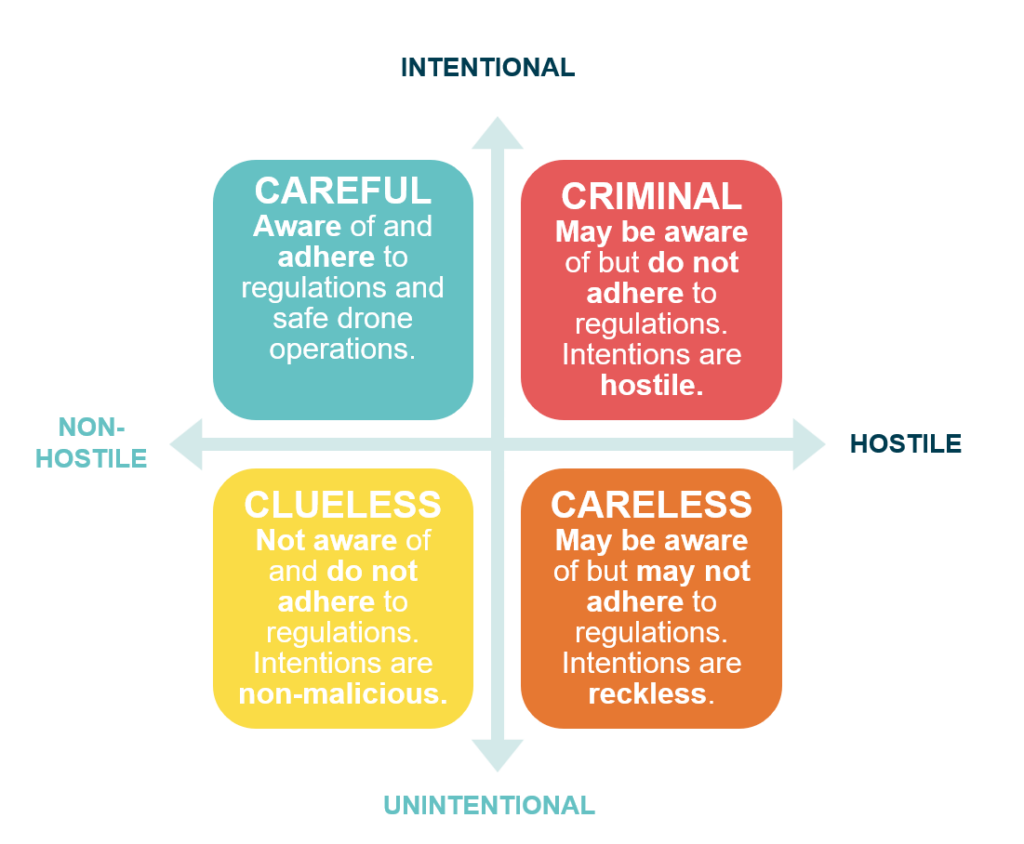
In short, U-space sounds like the ultimate solution to get to know who’s flying where in that U-space airspace. However, this assumes that all drone operators comply with the U-space regulation when flying in U-space airspace. This brings us back to the exact same problem we’re facing today: for those pilots who do not comply (clueless/careless/criminal – see image below) and operate their drone in a non-cooperative manner, a non-cooperative drone detection system is still needed.
So does U-space not change anything with regards to detecting unauthorised drones?
Especially for organisations who are not managing a geo-zone, it definitely does. Once a U-space airspace will be designated above their area of interest, they will no longer need to establish their very own geo-zone with associated flight authorisation system as they will be able to receive the data of all authorised flights through the CISP. Thanks to the data that the CISP will provide, any organisation located within a U-space airspace with a drone detection system will be able to separate the bad ones from the good ones, when comparing the data from the CISP with the detected drones.
In summary, U-space represents a significant step forward toward safe drone integration, but it doesn’t eliminate the need for non-cooperative detection. Organisations with a legitimate concern should still invest in a robust detection system to protect their airspace effectively. Learn more about SkeyDrone’s drone detection solution here.